
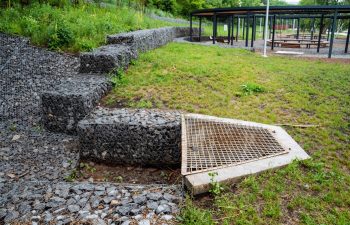
There is a pattern that plays out in North Atlanta yards every October. The summer’s worst heat has finally broken, the landscape looks like it has survived another brutal Georgia season, and then the rains come. Not the scattered afternoon thunderstorms of July, but the sustained, multi-day rainfall events that fall and tropical storm remnants bring to North Georgia — the kind of rainfall that exposes every drainage weakness a property has been hiding since spring.
The homeowners who handle this well are the ones who addressed their drainage concerns in August, before the rains tested them. The ones who didn’t are the ones calling in November about standing water that has been sitting for three weeks, erosion channels that appeared overnight, and the foundation moisture that is going to be a conversation with a contractor before spring.
At Mobile Joe’s Landscaping in Alpharetta, drainage and erosion control have been a core part of the business since Joe Archer founded the company in 1989. More than 35 years of working with North Georgia soil, topography, and weather patterns has produced a very specific understanding of what August looks like from a drainage preparation standpoint — and why the homeowners who act now consistently have better outcomes in fall than those who wait.
Why Fall Drainage Problems Are Different From Summer Ones
North Georgia’s rainfall is not evenly distributed across the seasons. The summer pattern — daily afternoon convective thunderstorms that deliver intense rainfall in short bursts — tests the surface drainage and infiltration capacity of the immediate soil. A yard that handles July thunderstorms adequately may still have drainage vulnerabilities that only appear under sustained rainfall events.
September and October in Georgia bring a different kind of rain. The remnants of Atlantic and Gulf hurricanes and tropical storms regularly track through the Atlanta metro area in early fall, delivering multi-day rainfall totals that can reach five to ten inches over 48 to 72 hours. Unlike a summer thunderstorm that tests an hour’s worth of drainage capacity, these events saturate the soil completely, eliminate any infiltration capacity that exists, and test whether subsurface drainage systems can manage the volume over an extended period.
This is when dry stream beds that were decorative features in July reveal whether they’re actually moving water away from the house. This is when retention areas that handled summer storms reach capacity and begin backing up toward foundations. This is when the corner of the yard that always looked a little damp in summer turns into a standing pond that doesn’t drain for a week.
The time to identify and address these vulnerabilities is in August — when the soil is workable, installation crews are available, and the drainage infrastructure can be in place before the events that will test it.
The Warning Signs Worth Addressing Before September
Not every yard has a drainage problem that requires engineered intervention. But certain patterns are reliable indicators that a property’s drainage is insufficient for what Georgia’s fall season will deliver:
- Water pooling near the foundation after moderate rain. Foundation moisture is one of the most serious consequences of inadequate drainage — and one of the most expensive to address when water penetration leads to structural or mold issues. Pooling within ten feet of the foundation after rainfall that doesn’t qualify as exceptional is a red flag that warrants drainage assessment before the high-rainfall months arrive.
- Erosion channels in lawn or planting beds. Linear erosion channels — visible evidence that water is concentrating and flowing in patterns that carry soil — indicate that water is moving across the property in volumes that the surface cannot absorb. Left unaddressed, these channels deepen over seasons, delivering increasing amounts of sediment to wherever the flow terminates. They also indicate that the water causing the erosion is not moving efficiently to an appropriate outlet.
- Areas that stay wet for more than 48 hours after rain. Soil that remains saturated for days after a rainfall event is soil that either lacks adequate subsurface drainage or receives more water than the area’s natural drainage capacity can manage. This saturation kills turf and plant roots over time and creates the waterlogged conditions that mosquitoes exploit aggressively during Georgia’s warm months.
- Grading that directs water toward rather than away from structures. Positive grading — the ground sloping away from the house and hardscape structures — is the most basic drainage requirement for any property. Settling, landscaping changes, and additions to structures can gradually alter grading until water moves toward a foundation rather than away from it. A grading assessment in August corrects this before fall rains test it.
What Mobile Joe’s Does Differently With Drainage
The drainage solutions that Mobile Joe’s Landscaping installs reflect the specific challenges of North Georgia terrain — the red clay soil that sheds water rather than absorbing it, the topographic variation across properties in Alpharetta, Milton, Roswell, and Cumming that creates significant runoff concentration, and the rainfall volumes that test drainage infrastructure more demanding than many other Southern metro areas face.
French drains, dry creek bed systems, channel drains, retention solutions, and regrading are all tools in the drainage toolkit — but the right solution depends entirely on the specific property’s topography, soil conditions, water volume, and outlet options. A French drain that solves one property’s problem creates a different problem on a property with different soil conditions. A dry creek bed that handles residential runoff can be overwhelmed by the drainage requirements of a larger lot or a property with significant hardscape area.
Joe Archer’s 35-plus years in North Georgia landscaping — and the specific expertise in drainage and erosion control that has been a Mobile Joe’s differentiator since the company’s earliest years — means every drainage assessment produces a recommendation calibrated to the actual conditions rather than a standard solution applied generically.
The Fall Planting Connection
August drainage work has a secondary benefit that homeowners often don’t anticipate: it prepares the property for fall planting. The fall growing season — September through November — is the most productive planting window in North Georgia, particularly for fescue renovation, perennial installation, and shrub and tree establishment. Plants installed in soil that has adequate drainage establish root systems more effectively than those planted in chronically waterlogged conditions.
Addressing drainage in August means the fall planting that follows is going into a prepared, properly draining environment. The combination produces landscape results that are simply not achievable when drainage problems persist through the growing season.
Schedule Your Drainage Assessment With Mobile Joe’s
Mobile Joe’s Landscaping serves residential and commercial clients throughout Alpharetta, Milton, Roswell, Cumming, Johns Creek, and the surrounding North Atlanta Metro area. Joe Archer and the Mobile Joe’s team are available for property assessments now — before fall scheduling fills and before the rain events that will define which properties were prepared. Call (770) 360-5604 or visit mobilejoeslandscaping.com to schedule your drainage assessment. What August addresses comfortably, October makes urgent.
Posted on behalf of
12460 Crabapple Rd. Suite 202 - 407
Alpharetta, GA 30004
Phone: (770) 360-5604
Email: [email protected]
Mon. - Fri. 8:30 AM – 7:00 PM